Player Development is the entirety of tennis growth, education, and performance.
essentially Tennis can be broken up in to a few volumes:
Volume 1) Learn to not lose to yourself
Volume 2) Learn to Beat your opponent
Volume 3) Learn how to manage yourself
Volume 4) Learn to have a career
Below is every area and concept you will need to know and a macro and micro outlook at the world of player development. Follow the links for more information!
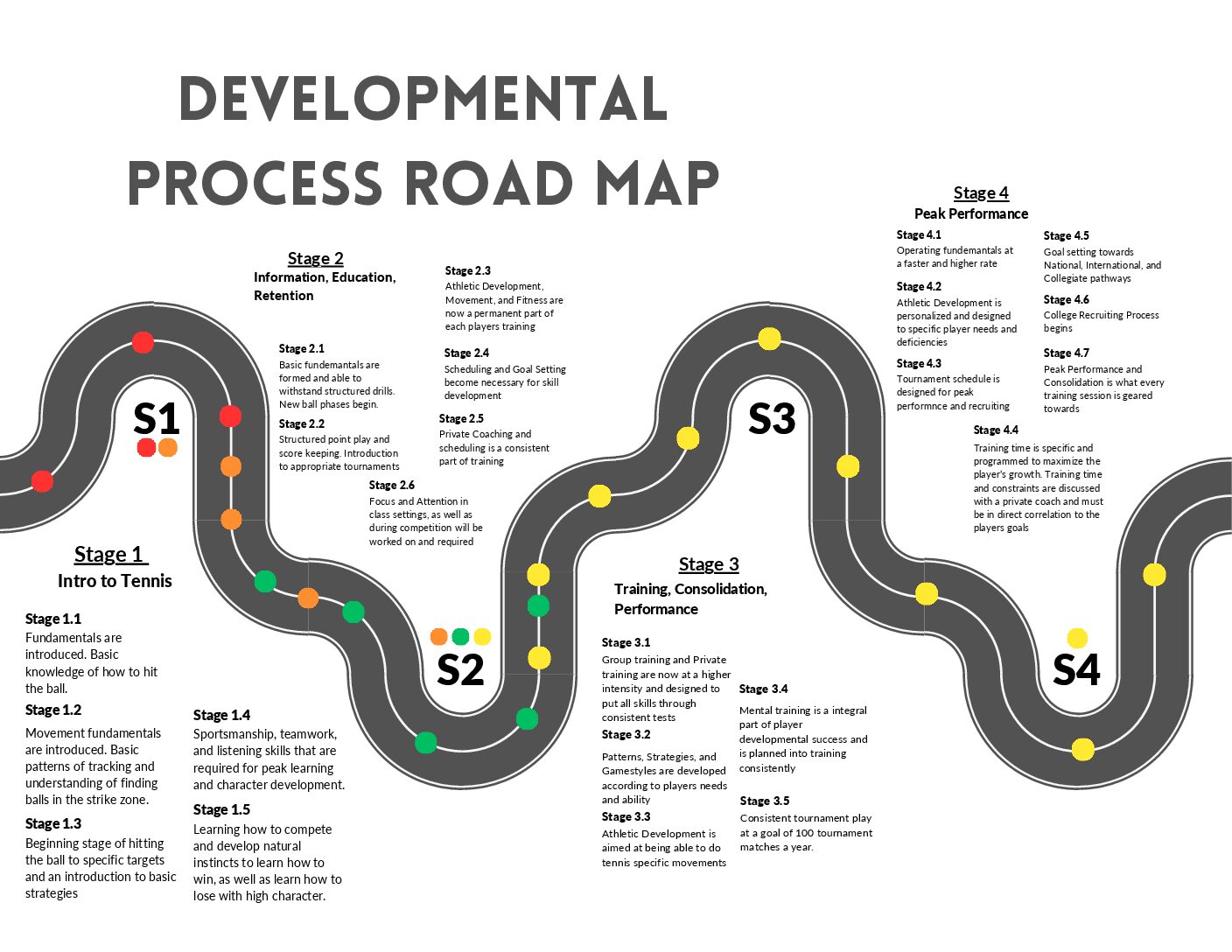
Each Stage in the Developmental Process Roadmap is labeled and given an overview. Identify where you are in your process and make sure you are hitting those parameters.
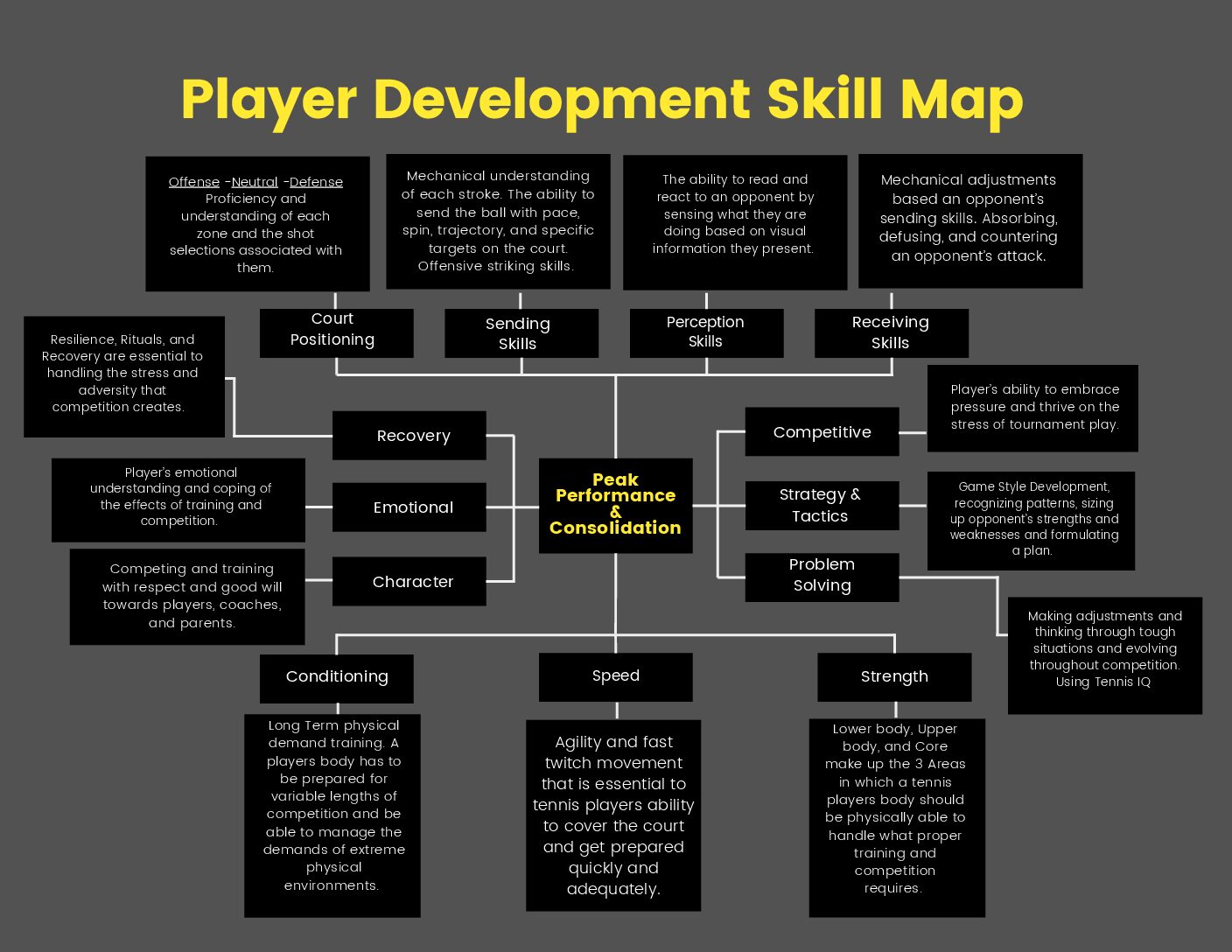
There are 13 Skill Sets you need to grow and know. They encompass the full spectrum of training the mind, the body, and the heart to be able to compete at the highest levels.
Competitive excellence is built from the ground up by developing disciplined habits, resilient character, and elite skills that consistently produce peak performance under pressure.
Training your brain is just as important as training your body. Tennis is an anticipatory sport that requires problem solving and emotional intelligence. 90% of the time you are playing you are not hitting a ball. Make sure that you are training what you are doing when you are not.
Brain Performance
Unlock your ability and manage your mind
Strategy and Tactics
Learn to play with your strengths, attack weaknesses, and compete with clarity
Learn to Win
Execute with confidence, compete without fear
Tough Truths
You need to know
Parent Education
Common Discussions and Tough Topics
What does the road look like? Every stage and level is mapped out below. Stage 1 being introductory and Stage 4 being a complete player and ready to move on to the highest levels of tennis.
Player Development
Performance and Consolidation
Court positioning, sending skills, receiving skills, perception skills, competitive skill, problem solving, strategy and tactics, conditioning, strength, speed, mental recover, emotional intelligence, and character.
100+ Competitive matches or tournament matches a year minimum is pretty average for high level committed players. 20-30 tournaments a year, depending on age and level. Your goals for performance and ranking may vary the schedule but testing your ability and skills during competition is the most important form of feedback.
What Areas of Focus are you the least proficient in and what are the strongest? Develop your strengths, work on your weaknesses, and always look to improve.
Training off the court is just as important as training on the court. Developing a plan to retain knowledge, establish routines, and create coping skills for on court stress. Build a strong sense of self so that you can meet the demands of the sport.
Foundational Concepts
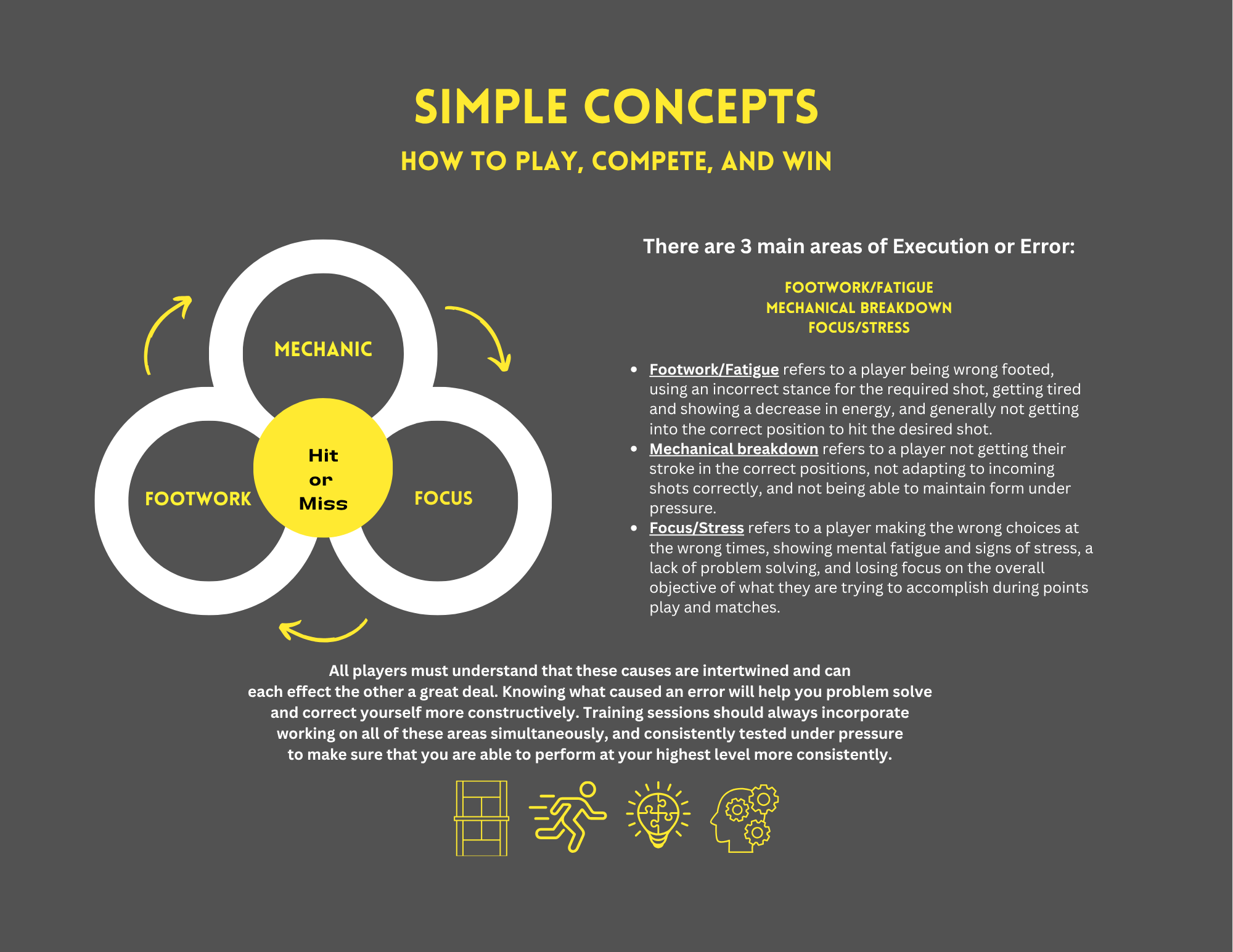
The Rule of 3
There are 3 reasons someone executes or misses a shot. The Rule of 3 is the relationship between these 3 reasons. They are: Footwork, Focus, and Mechanics. Everything you do on the court, all of your training, and all of your competing, surrounds these 3 areas. Did you read or see the ball, did you move and find balance, and did you hit it correctly? They all affect each other, are completely intertwined, and you are going to always be in a constant battle to refine and perfect each one.
Footwork
Footwork is an essential aspect of playing tennis, and having excellent footwork can be the difference between winning and losing. It encompasses a wide range of movements and techniques, and is often considered the foundation of a strong tennis player. There is interior movement, exterior movement, different stances, and multi-directional recovery and more. Proper footwork allows players to move quickly, efficiently, and effectively on the court, which is crucial for success in the fast-paced and unpredictable game that we play. Other areas under the Footwork umbrella are conditioning and endurance, strength and power, as well as speed and agility. Working on all of these areas consistently, and dedicating a large part of your training to them, can be a determining factor in how much you grow as an athlete and competitor.
Focus
Focus is a crucial aspect in the game of sports. It involves being fully present and aware of what is happening on the court. This means that not only your physical execution, but also your mental execution plays a significant role in your performance. Simply, 50% of the time you’re watching what you did after you hit the ball- the remaining 50% is spent reacting to what your opponent is doing. Time-wise you’re looking at about 3 seconds in between shots this is where the real work happens. With each shot, your mind is quickly processing information and calculating your next move. This requires a high level of perception and anticipation skills, which great players possess. They appear to have quick reactions because they are constantly one step ahead, and they seem composed and in control because they are able to recognize shots faster and move smoother. Training your ability to Focus into instinctive reactions and behaviors is very important When 90% of your time on the court is spent not hitting the ball, there is an argument that it’s the most important thing you can train.
Mechanics
Mechanics in tennis are broken down in to 2 main skills, Sending and Receiving. These two skills have 5 main areas in which a tennis player is able to play the ball: Serve, Return, Forehands, Backhands, and Volleys (any shot out of the air). Of course from there it gets exponentially more difficult. Each area has so many different variations to what you’re able to do with the tennis ball and your ability to move through those variations can have a great impact on what you’re able to do on the court. Every player should have a very strong foundation in which their mechanics are built. The more sound the mechanics with less complication, the less likely they are to break down under pressure. Operating in a sport that requires so much calculation and movement, the last thing that you want to be worried about is if your mechanics will be able to hold up. The relationship of mechanics to the other 2 main areas can be very tough. If you don’t have the proper footwork and can’t get set up well, your mechanic will break down. If you do not perceive or recognize shots efficiently, your mechanics will break down. Train your mechanics to the point they are instinctive and simple so all you have to do is focus on the other 2 areas that drive you.
Below are some visuals to help guide you through Sending, Receiving, Perception, and Anticipation Skill Concepts